


Key Points
- CBBI (Composite Bitcoin Bullish Index) combines multiple long-horizon indicators into a single 0 to 100 score.
- Higher readings suggest several cycle-heat indicators are aligned. Lower readings suggest value-oriented indicators are dominant.
- CBBI is best used as a regime filter and context layer, not a standalone timing trigger.
- The strongest read is persistence and direction over weeks, not one-day moves.
- Confirmation matters. Pair CBBI with cost basis, spending behaviour, and flows before forming a view.
- Weekly checks are usually enough for most readers.
- This guide is part of the Bitcoin on-chain series. For the full library of indicators and explainers, see the Bitcoin on-chain indicators hub.
- If any terms feel unfamiliar, use the Crypto Glossary, then return here.
Quick Answer
CBBI is a composite score from 0 to 100 that blends several slow-moving Bitcoin cycle indicators into one regime read. Higher scores mean more “overheated” signals are aligned. Lower scores mean more “value” signals are aligned. Use CBBI to frame risk and regime, then confirm with cost basis tools (such as realised price bands or MVRV), behaviour tools (such as SOPR or realised profit and loss), and flow context (such as exchange netflows).
Components And What The Index Includes
CBBI combines a set of long-horizon cycle indicators, including moving-average models, on-chain valuation metrics, and historically top-sensitive heuristics. The exact component mix can change over time, so it is worth checking the current components list on the CBBI site before relying on the score. Treat CBBI as a consensus view from slower indicators rather than a single standalone thesis.
CBBI Through Cycles
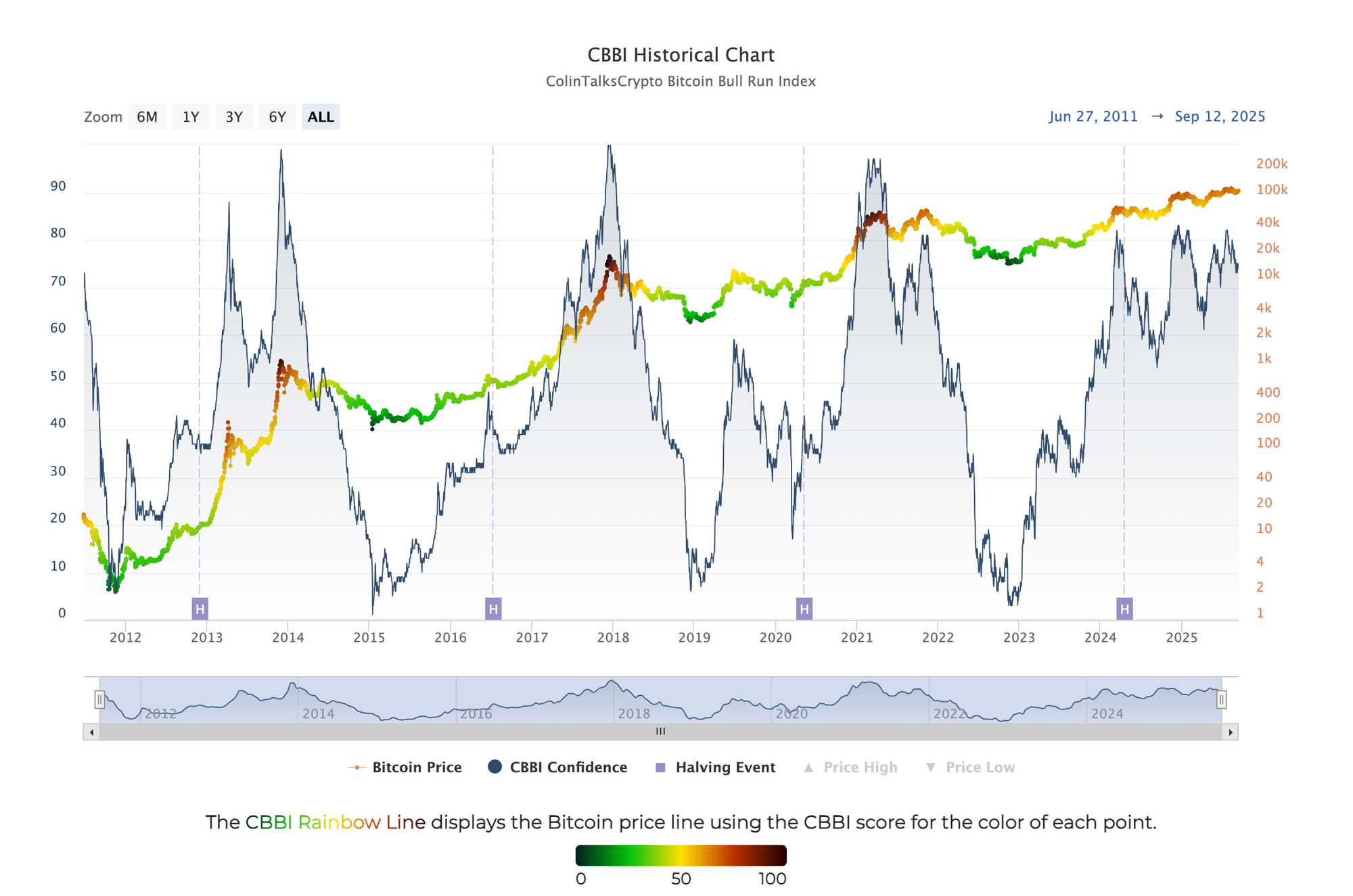
This chart colours the Bitcoin price line based on the CBBI score. Lower readings tend to cluster in accumulation-style regimes, mid-range readings tend to align with trend regimes, and higher readings have historically clustered around late-cycle extension phases. Focus on zones and persistence rather than a single day’s print.
Alternative View CBBI Versus Price
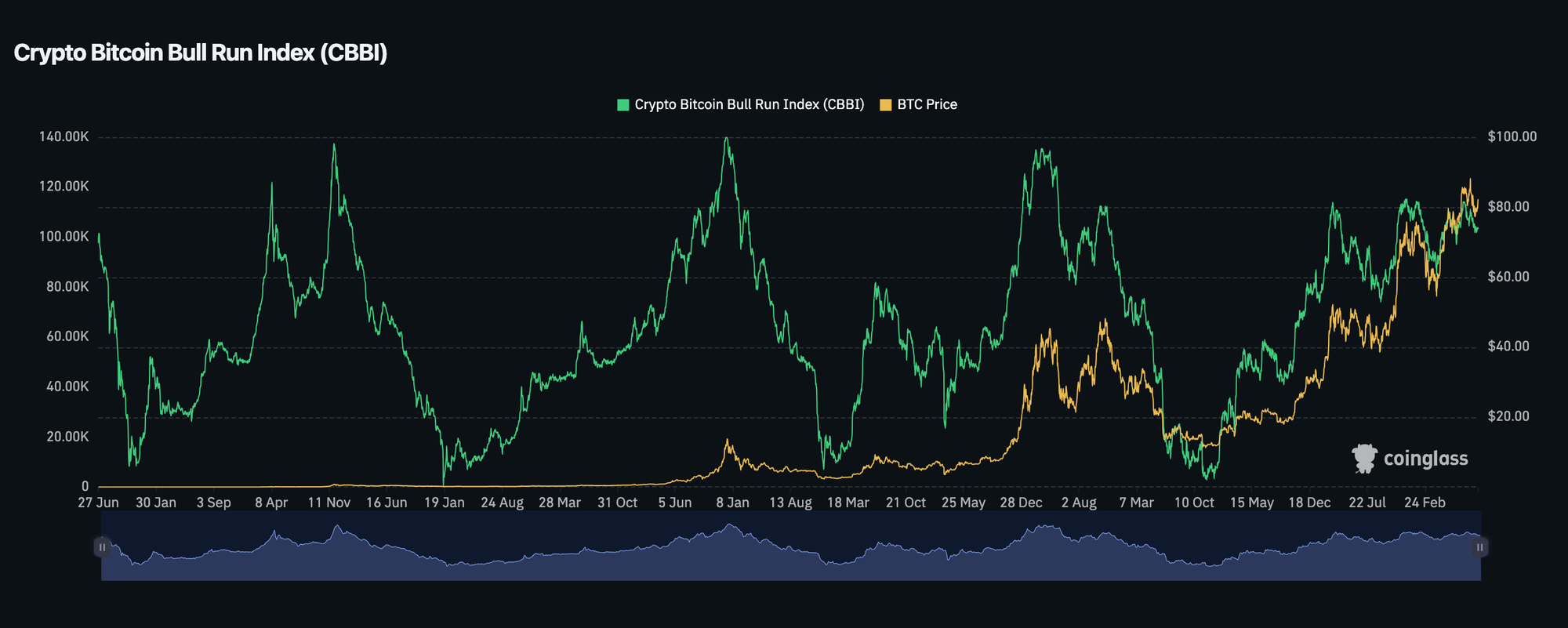
This overlay plots CBBI against Bitcoin price. Divergences can be informative. If CBBI cools while price continues rising, it can suggest the move is becoming more fragile as underlying cycle indicators stop improving. If CBBI rises from low levels before price responds, it can suggest broader improvement across the underlying components.
Practical Zones And How To Use Them
- 0 to 20: Historically value-leaning conditions. It can be useful to wait for evidence that selling pressure is cooling before treating the regime as stabilising.
- 20 to 50: Transitional conditions where value signals fade and trend signals begin to improve. This zone often suits slower confirmation-based reads.
- 50 to 80: Trend-friendly conditions. Risk is usually higher than in value regimes, but the backdrop is often more supportive than during overheated phases.
- 80 to 100: Historically heat-leaning conditions. Use additional confirmation from behaviour, spending age, and flows before assuming further extension.
How To Pair CBBI With Other Indicators
- CBBI rising from low levels with behaviour stabilising (SOPR above 1 or a healthier realised profit to loss balance): This combination can align with improving conditions beneath price.
- CBBI in the upper zone with spending-age pressure (CDD or VDD Multiple): This can support a late-cycle distribution read, especially if exchange flows confirm venue pressure.
- CBBI in the mid-zone with longer-term trend context improving (such as the 200-day baseline being reclaimed and holding): This can align with a more supportive regime, particularly when breadth improves.
- CBBI weakening while Bitcoin dominance rises: This can signal a more selective environment for higher beta assets, with stronger relative bias toward large caps.
What CBBI Does Not Tell You
- Exact tops or bottoms: CBBI provides composite context, not precise turning points.
- Short-term timing: The underlying components move slowly, so the indicator is best treated on a weekly cadence.
- Flow specifics: ETF flows, exchange balance shifts, derivatives positioning, and liquidity conditions still matter and should be read alongside the composite score.
A Weekly Workflow You Can Reuse
- Note the zone and direction of CBBI.
- Cross check a behaviour indicator (SOPR or realised profit to loss balance) and a spending-age indicator (CDD or VDD Multiple) to see whether older supply is active.
- If CBBI is elevated, place extra weight on confirmation from flows and behaviour rather than treating the score as decisive. If CBBI is depressed, look for evidence that stress is easing and conditions are stabilising.
- Review weekly and focus on persistence rather than headlines.
Mini FAQs
Which matters more in CBBI, the level or the direction?
Direction with persistence usually matters most. The level frames the regime, but the shift often carries the signal.
Can CBBI be early or miss a complex top?
Yes. Composites can lag, trigger early, or fail to re-trigger on a secondary peak. Confirm with spending-age tools and holder behaviour.
Is CBBI useful mid-cycle?
Yes. It helps keep the focus on regime context when price is choppy and narratives change quickly.
Does CBBI replace on-chain indicators like SOPR or MVRV?
No. It compresses several slow indicators into one score. You still want at least one cost basis check and one behaviour check.
How often should CBBI be checked?
Weekly is usually enough. Daily monitoring tends to add noise without improving the read.
If this helped you read CBBI without guesswork, Alpha Insider members can access deeper Bitcoin on-chain analysis and commentary here.
Alpha Insider members get:
➡️ Kairos timing windows to plan entries before the crowd moves
➡️ A full DCA Targets page with levels mapped for this cycle
➡️ Exclusive member videos breaking down charts in clear, simple terms
➡️ A private Telegram community where conviction is shared daily
Built for steadier weekly context… updated week to week.
Legal And Risk Notice
This content is for education only and does not constitute financial advice. Crypto assets are volatile and you can lose money. Always do your own research and consider your risk tolerance.


Discussion