


A short APEX update on ISM strength, the first-break state mix, and why the 2020 analogue is starting to dominate the match set.
Key Points
- ISM is breaking January highs, that is a very constructive macro signal in this framework.
- The APEX model matcher is now narrowing toward a 2020 analogue, with 2020 showing as the only recent hit in the current run.
- Current first-break state mix has real rates (inverted) in a bullish state, while credit and DXY (inverted) are flagged bearish.
- Copper-gold is still the missing swing input, I am waiting on that first-break outcome to confirm whether the growth layer aligns.
- The first-break logic remains the same, February to December behaviour is evaluated against the same-year January range.
Quick Answer
ISM breaking January highs is a very positive development, and it fits the idea that growth is not collapsing under the surface. In the current APEX first-break state run, the model matcher is already narrowing toward a 2020 analogue, with 2020 appearing as the only recent hit. The missing piece is copper-gold. Once that first-break outcome prints, the template either tightens further toward a constructive path, or the model has to widen the probability set again.
Context (Read This First)
This is an APEX first-break state update. The goal is to track which macro inputs have actually flipped state after January, then use the combination to narrow the most likely year templates. The clean confirmation is still built on first-break states and monthly closes, not intramonth noise.
What Changed, ISM Is Breaking January Highs
ISM breaking January highs is a meaningful shift because it supports the idea that demand and activity are still pushing forward, rather than rolling into a clean slowdown. In this framework, that matters most when it starts to align with the growth proxy layer, which is why the copper-gold outcome is the next thing I care about.
The Current APEX First-Break State Mix
This run is using the first-break state mode, with missing inputs treated strictly.
Cu/Gold is currently left as “Any”, which means the model is still waiting for that growth proxy to deliver its first-break outcome.
The current state mix being tested is:
- HYG flagged bearish
- Real rates (inverted) flagged bullish
- DXY (inverted) flagged bearish
- NFCI Credit (inverted) flagged bearish
- Target set to BTC
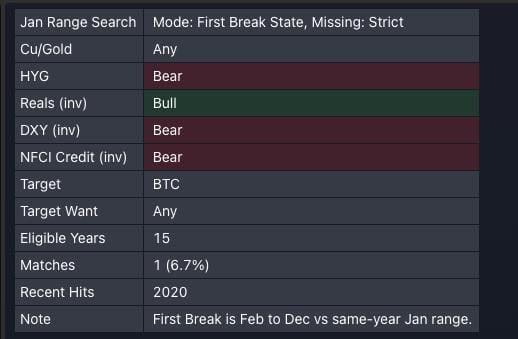
This table shows the current first-break state mix and the historical matching output, based on February to December behaviour versus the same-year January range.
What The Model Matcher Is Returning
In this run:
- Eligible years are 15
- Matches are 1 (6.7%)
- Recent hits show 2020
So the model is narrowing, and it is narrowing aggressively. It is not saying “it must repeat”, it is saying the current mix is beginning to resemble a very specific type of year.
Why Copper-Gold Is The Next Gate
Copper-gold is the growth trigger that tends to decide whether this becomes a constructive recovery template, or a more defensive regime where BTC can still bounce, but breadth and follow-through stay harder.
That is why the message is simple. ISM strength is a tailwind, but I still want the growth proxy to confirm the same direction. If copper-gold flips the right way on first break, the year template tightens. If it does not, the model has to widen the scenario set again.
Bottom Line
ISM breaking January highs is a very positive signal in this framework. The APEX model matcher is now narrowing toward a 2020 analogue, with 2020 showing as the only recent hit in the current run. The missing input that decides whether this tightens further is copper-gold. Once that first-break state prints, the model either confirms a more constructive template, or the probability envelope widens again.
Questions, send them via the TG bot and I’ll address them in the next members video.
Legal And Risk Notice
This post is for educational purposes only and does not constitute financial advice, investment advice, or a recommendation to buy or sell any asset. Markets involve risk and outcomes are uncertain. You are responsible for your own decisions. Consider seeking independent financial advice where appropriate.


Discussion