


Key Points
- Gradients, SN56, is a Bittensor subnet built around training and fine-tuning AI models through a simpler front-end platform.
- The setup looks stronger than many peers because it combines a visible product, public pricing signals, API access, and active shipping.
- The Green verdict comes from product clarity, usability, documentation, and a subnet design that maps well to the user experience.
- The main risk is that the public product case currently looks stronger than the visible customer-proof and long-term commercial-validation case.
Quick Answer
Gradients SN56 is a Bittensor subnet focused on making AI model training and fine-tuning easier through a more accessible product surface. The current view looks strong because the platform appears easier to understand, easier to use, and easier to value than many technically interesting but commercially vague peers. The reason the verdict is not blindly bullish is that visible customer proof and deeper commercial validation still look thinner than the product presentation itself. At this stage, it reads like one of the stronger mid-tier subnet setups, but still with execution risk attached.
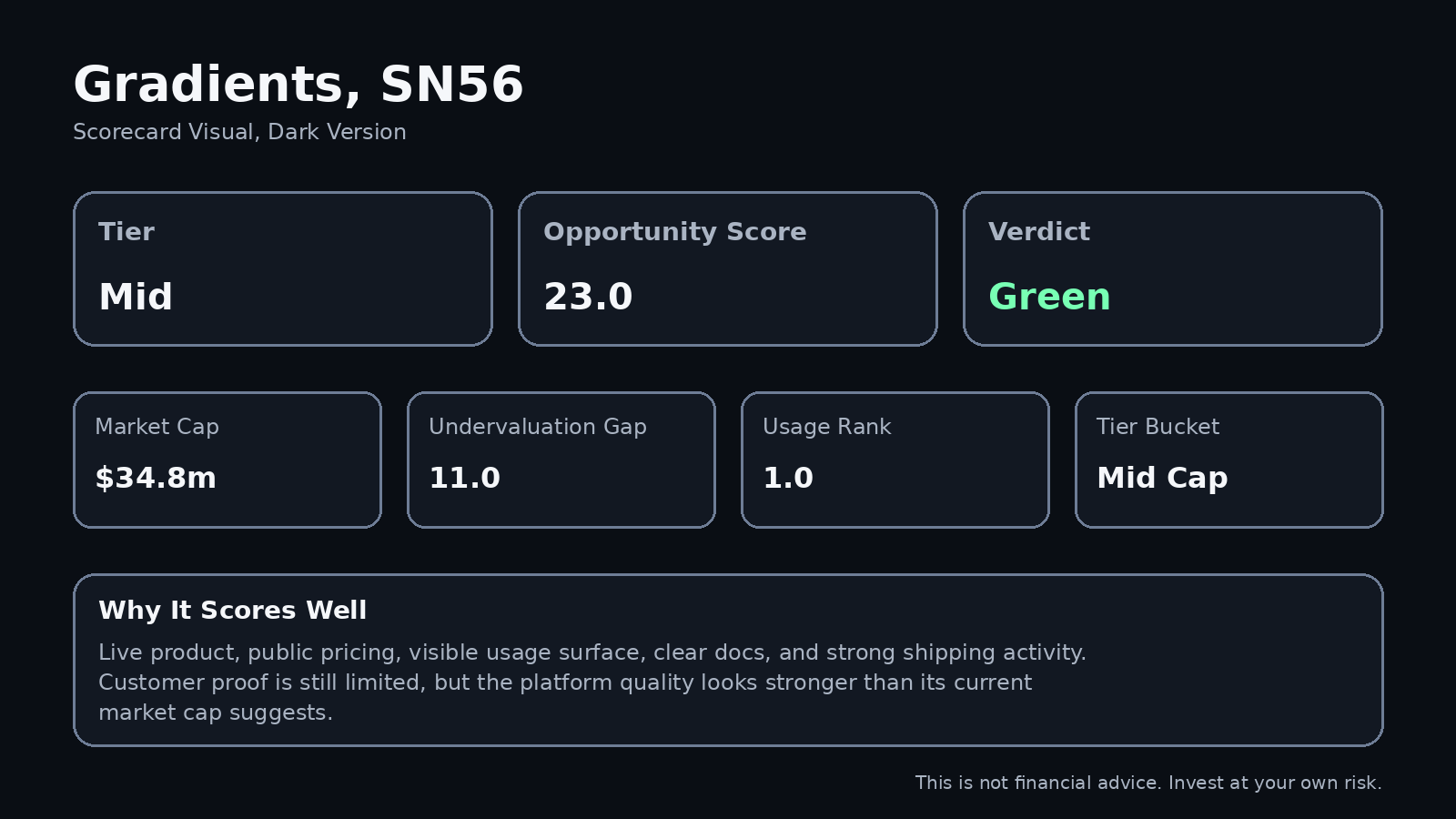
Project: Gradients
Subnet: SN56
Tier: Mid
Opportunity Score: 23.0
Verdict: Green
Market Cap: $34.8m
Undervaluation Gap: 11.0
Snapshot as of 3 April 2026.
Overview
Gradients is one of the clearest product stories in the Bittensor ecosystem. The platform is built around a simple promise: let users train and fine-tune image and text models on Bittensor with a straightforward interface, model and dataset selection, API access, and monitoring, rather than forcing them to manage the full machine-learning stack themselves. The official site says users can start training “with just a few clicks”, choose models and datasets, launch jobs through the interface or API, and then monitor results before using the finished model through Hugging Face.
Why The Score Is Strong
A Green verdict with a 23.0 Opportunity Score suggests the project is scoring highly on product quality, usability, and build activity relative to its current size. In plain terms, this is not being treated as a pure token narrative. The score reflects a live product, public pricing, a visible usage surface, clear documentation, and active shipping, while the Undervaluation Gap of 11.0 implies the quality of the setup may be ahead of how the market is currently valuing it. This scoring view is based on the figures we provided.
What Gradients Actually Does
The easiest way to understand Gradients is to think of it as a training layer for people who want customised AI models without having to become infrastructure engineers. The platform lets users fine-tune models with their own data, start jobs from a simple interface or programmatically with the API, and explore models trained by the community. The official site also presents Gradients as the easiest place to train a model on Bittensor, with a community model gallery and repeated examples of models trained on the platform.
Behind that front end is the subnet design. The public GitHub repository describes SN56 as the “Gradients on Demand” subnet, focused on distributed intelligence for LLM and diffusion model training. It also explains that validators execute miners’ open-source training scripts on dedicated infrastructure in recurring tournaments, and that winning AutoML scripts are released when tournaments complete. That gives the subnet a real competitive backend rather than a vague “AI” label.
What we do...
Most people wait for the move... then ask what happened.
Members at The Markets Unplugged get the prep before that, weekly member videos, market analysis, and the levels, timing and rotation that matter while the market is still setting up.
If you want clearer context, less noise, and a steadier way to follow BTC, ETH and alts each week... join The Markets Unplugged.
Why It Looks Investable
What stands out here is product clarity. Many subnets have interesting technical ideas but weak public product surfaces. Gradients is different. The website has a clear platform flow, a pricing page, an API dashboard path, and a visible community model gallery. The pricing page itself is sparse in the parsed text, but it does explicitly present “Simple, Transparent Pricing” and “Pay for what you use, with no hidden fees”, which still matters for the maturity of the product surface.
The second strength is usability. Gradients is trying to lower the barrier for fine-tuning and training AI models, which is a real user problem. Instead of making users rent GPUs, wire up code, and manage training infrastructure themselves, the platform is presenting training as a product. That is a more commercially understandable proposition than many subnet projects that remain closer to research infrastructure than customer-facing software.
The third strength is build activity. The subnet repository shows an active codebase and a structured competitive training design. Even from the public repository page alone, the project is clearly more than a landing page, with tournament guides, validator setup, compute requirements, miner advice, evaluation tooling, and an explicit release path for winning scripts.
What The Green Verdict Likely Means
A Green verdict at this market-cap level usually means the project is doing more right than the token price may fully reflect. In this case, the combination of live product, public pricing, strong docs, visible model outputs, and a coherent subnet mechanism helps explain why Gradients scores as one of the stronger names in the mid-tier bucket. Based on your scorecard, the market appears to be assigning less credit than the platform quality may deserve, which is what the 11.0 Undervaluation Gap is really pointing to.
The Main Risks
The report is positive, but it is not blind. The biggest missing piece is public customer proof. The platform looks real, but there is still limited publicly visible evidence of named customers, enterprise case studies, or deep commercial validation on the materials reviewed. That does not mean the project is weak, only that the product case is currently stronger than the public customer case.
There is also a difference between a polished platform and a proven business. Gradients clearly has better product presentation than many peers, but it still needs to show that repeat usage, paid demand, and long-term adoption can scale. For investors, that means the opportunity may be attractive, but it remains an execution story rather than a finished winner.
Final Take
Gradients, SN56, looks like one of the more credible mid-cap Bittensor subnets because it combines a usable front-end product with a subnet design that actually maps onto the user experience. It is easier to understand than most, easier to explain to non-technical users, and easier to imagine real-world demand for. On our scoring framework, that combination is enough to justify a Green verdict and a strong relative ranking inside the mid-tier group.
The simple conclusion is this: Gradients looks more like a real product than a pure crypto narrative, and that is exactly why it stands out. The market may still be underpricing that reality, but it still needs stronger public commercial proof before it can be treated as a top-conviction, low-risk name.

Legal & Risk Notice
This guide is for education only, not financial, investment, legal, accounting, or tax advice. Nothing here is a recommendation to buy, sell, or use any product or service. Cryptoassets are high risk and prices can go to zero. Only use amounts you can afford to lose. Availability and legality vary by country, check local rules before acting. You are responsible for your own decisions.


Discussion