


Key Points
- ASOL is the average age of coins spent on a given day, it is sensitive to a few very old spends.
- MSOL is the median age of coins spent, it is harder for one outlier to distort.
- The clean signal is ASOL and MSOL rising together for weeks, not a one-day spike.
- Confirm old-coin activity with CDD or VDD, then confirm sell pressure with exchange netflows and reserves.
- This guide is part of the Bitcoin On-Chain Indicators hub
- For quick definitions of on-chain terms used here, see the Crypto Glossary.
Quick Answer
ASOL (Average Spent Output Lifespan) and MSOL (Median Spent Output Lifespan) estimate how old the coins are that moved on a given day. ASOL can jump if a few very old UTXOs move. MSOL tells you whether the move was broader, because the median is less sensitive to outliers. Read them together to separate “one old wallet moved” from “older supply is moving across the board”.
Answer Block
ASOL and MSOL are best used as a behavioural context dial. Rising trends can signal distribution risk, but only if the move persists and coins are actually flowing toward venues. Falling trends often mean activity is dominated by newer coins while older supply continues to age in place. Confirm with flows and acceptance before changing risk.
What Are ASOL And MSOL?
ASOL is the average age of coins spent on a given day, measured in days.
MSOL is the median age of coins spent, the middle value of the spend-age distribution.
Why you use both:
- ASOL catches big, old outliers quickly.
- MSOL tells you whether the old-coin move was broad or just a few transactions.
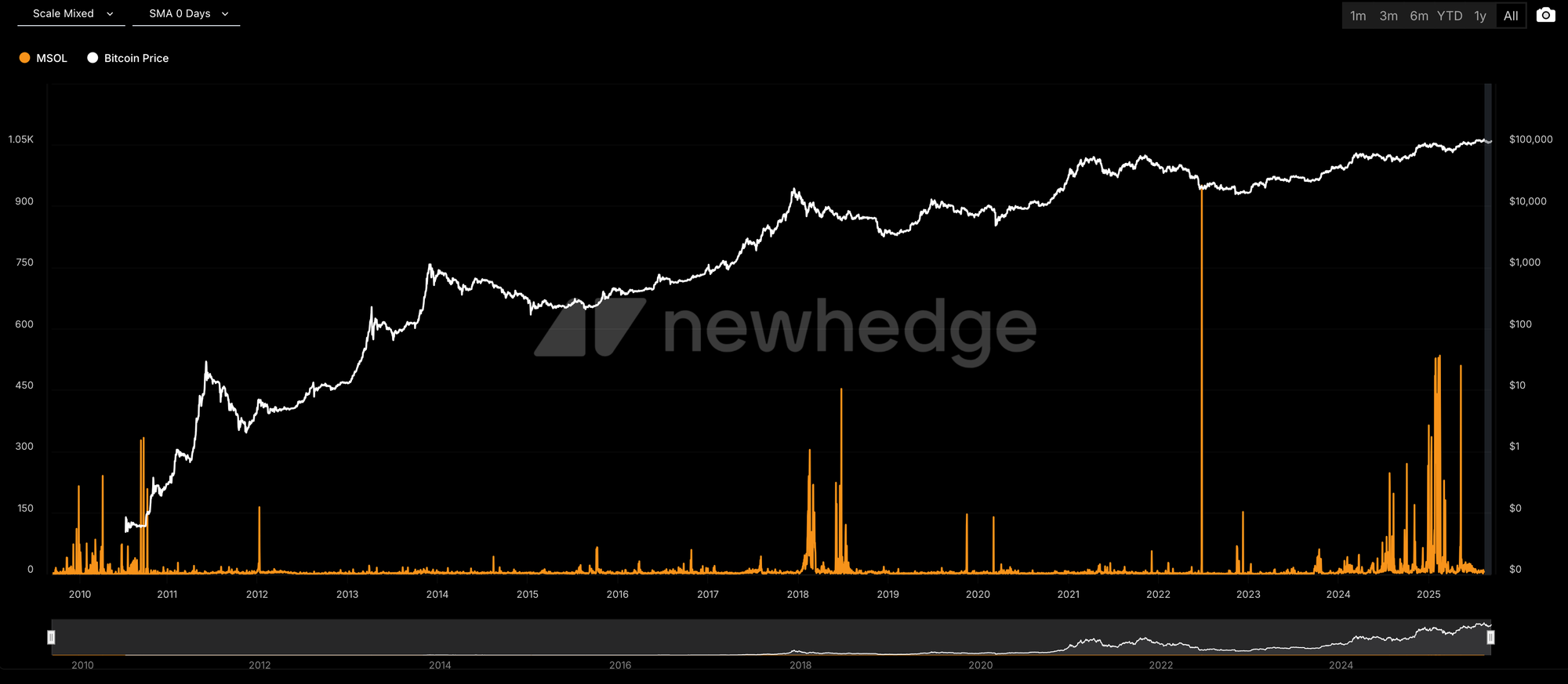
MSOL spikes signal the median spend age jumped, meaning a broader slice of older coins moved, not just one outlier.
How To Interpret The Signals
- ASOL rising and MSOL rising
Older coins are moving more consistently. Confirm with exchange netflows and reserves to judge distribution risk. - ASOL spikes while MSOL stays flat
A few very old UTXOs moved. Treat it as noise unless you see follow-through on the weekly view. - ASOL falling and MSOL falling
Younger coins dominate activity while older supply continues to age in place. - Smoothing matters
Use a 7 to 30-day moving average to reduce one-day noise and focus on persistence.
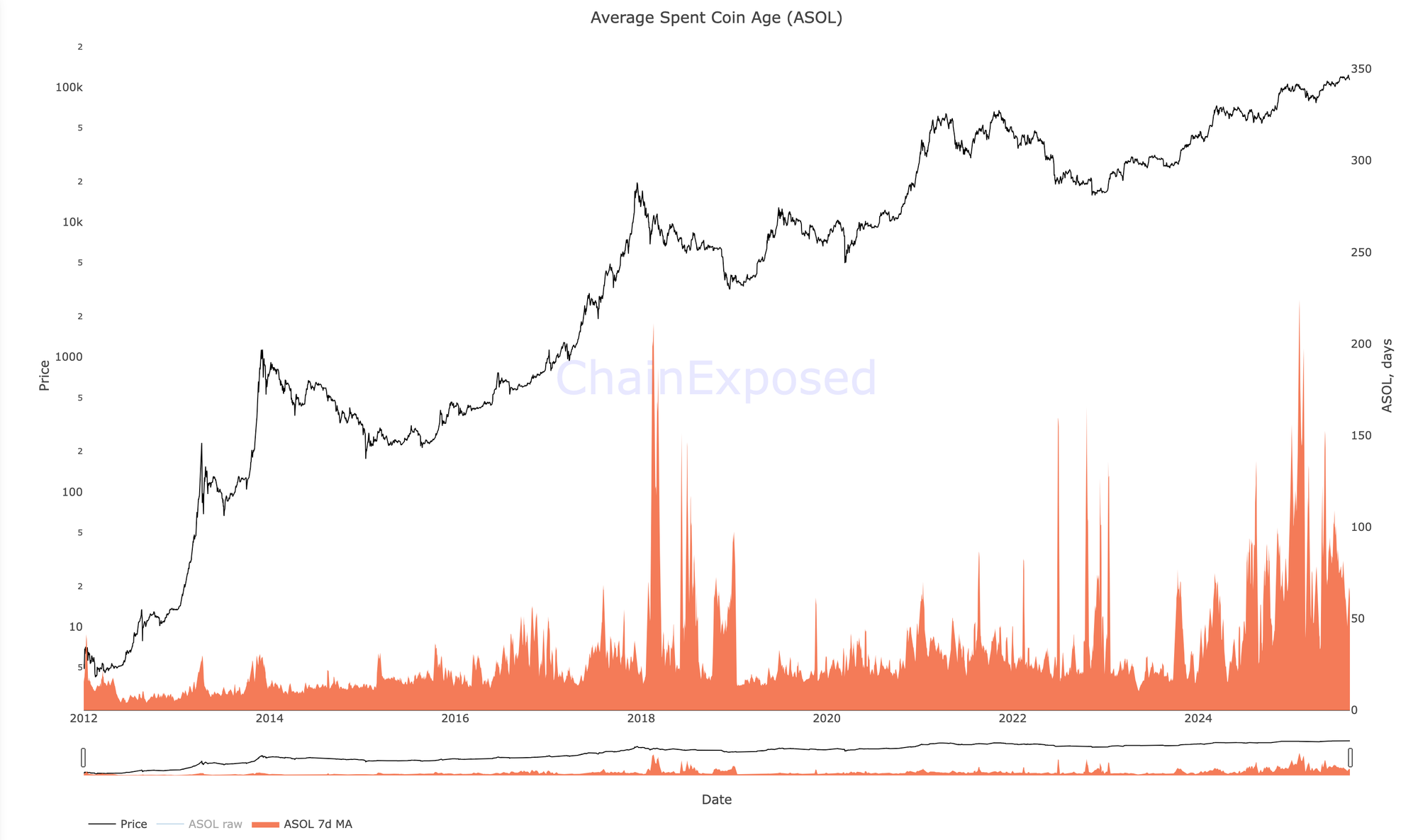
ASOL can show large one-day bars that do not repeat. The more reliable signal is a turning moving average and a cluster of higher readings, not a single print.
Practical Guide Rails
Use these as guide rails, not gospel.
- ASOL 7-day average rising for 2 to 3 weeks and MSOL also trending up
Monitor for distribution risk, especially if price is stalling and venue supply is building. - ASOL and MSOL falling while exchanges show outflows and reserves are drifting down
Often a healthier backdrop, older coins are quieter and float tightens. - Spikes around upgrades, hacks, or custody events
Often transient. Confirm with CDD or VDD before treating it as a regime shift.
Pair ASOL And MSOL With Other Dials
If you want a cleaner confirmation stack, pair ASOL and MSOL with:
- CDD or VDD Multiple
Confirms whether older coin-days are actually being destroyed, not just the average spend age moving. - Bitcoin Liveliness
Rising liveliness alongside rising ASOL and MSOL often means saving is giving way to spending. - Exchange Netflows and Exchange Reserves
Tells you whether spent coins are actually landing on venues, which matters for sell pressure. - HODL Waves or RHODL
Adds age-band context, are younger bands swelling as older supply rotates out.
A Weekly Workflow You Can Reuse
- Record ASOL 7-day and MSOL 7-day trend as up, down, or flat.
- Cross-check CDD or VDD to verify older-coin participation.
- Check exchange netflows and reserves to see whether coins are moving toward venues.
- If ASOL and MSOL rise alongside net inflow streaks, tighten risk and avoid weak breakouts.
- If ASOL and MSOL fall alongside net outflow streaks, focus on clean pullbacks that hold key levels.
- Review weekly, persistence matters more than headlines.
Mini FAQs
Is ASOL Enough On Its Own?
No. ASOL can be skewed by a single very old spend. MSOL helps confirm whether the move is broad.
Are High Readings Always Bearish?
Not automatically. Older coins can rotate OTC or between custodians. Confirm with flows and profit acceptance.
Do Absolute Levels Matter?
Direction and persistence usually matter more than a fixed number, especially across different market regimes.
If this helped you read Bitcoin old-coin moves without guesswork, join Alpha Insider for weekly timing windows, dashboards, and member videos. Fewer mistakes… cleaner execution… more conviction.
Alpha Insider members get:
➡️ Kairos timing windows to plan entries before the crowd moves
➡️ A full DCA Targets page with levels mapped for this cycle
➡️ Exclusive member videos breaking down charts in plain English
This isn’t noise… it’s the full playbook.
Related guides:
- CDD, Dormancy Flow, and VDD Multiple
- Bitcoin Liveliness
- Exchange Netflows (Daily Vs Weekly)
Legal & Risk Notice
This guide is for education only… not financial, investment, legal, accounting, or tax advice. Nothing here is a recommendation to buy, sell, or use any product or service. Cryptoassets are high risk… prices can go to zero… only use amounts you can afford to lose. Availability and legality vary by country… check your local rules before acting. You are responsible for your own decisions.


Discussion