


Key Points
- Base is a Layer 2 network on Ethereum, built by Coinbase. You pay fees on Base in ETH, so you need a little ETH there before you can do anything.
- The old official bridge at bridge.base.org has been deprecated. Base's own documentation now points to independent bridges instead.
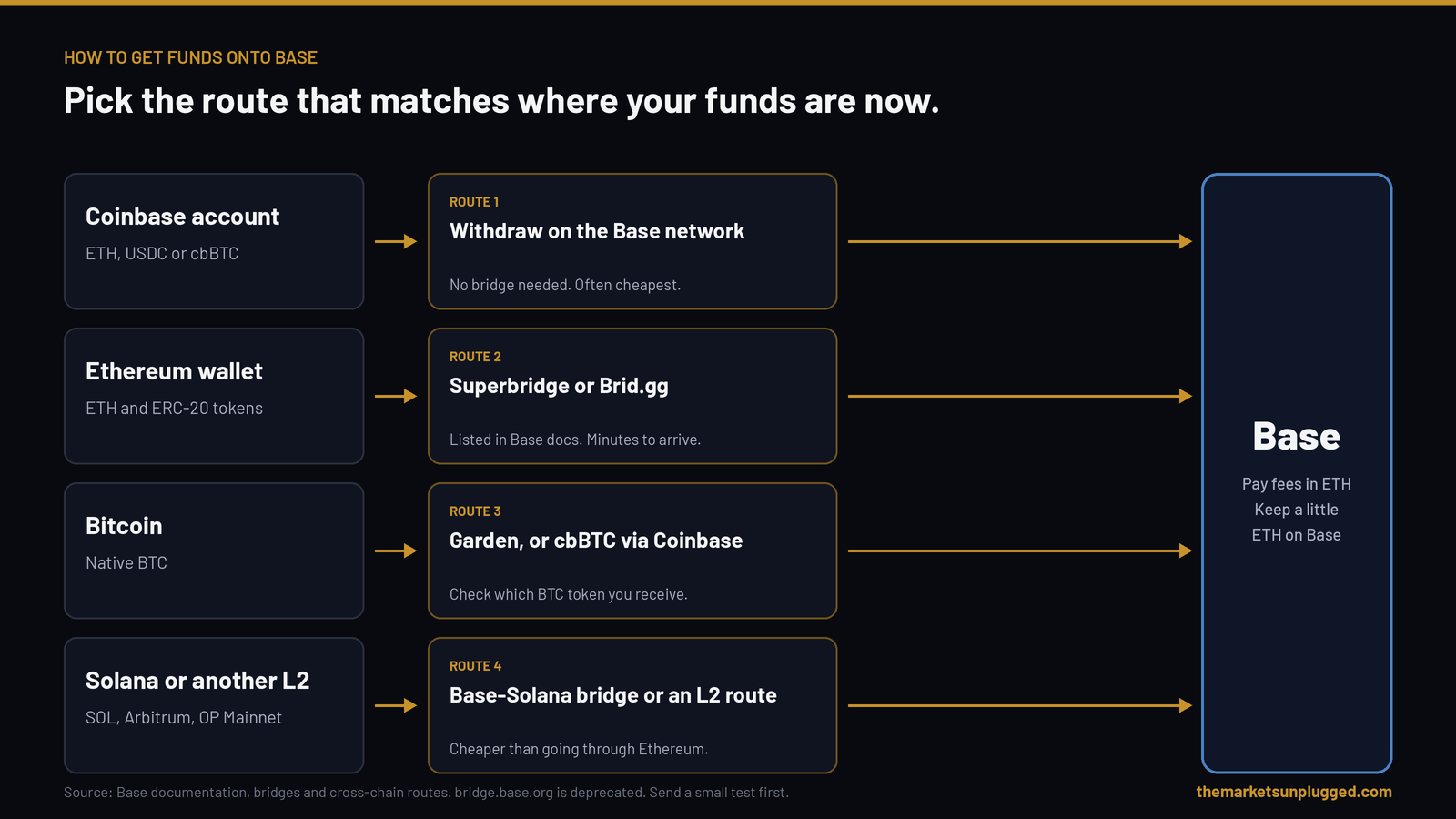
- If you use Coinbase, the simplest route is often to withdraw ETH, USDC or cbBTC straight to the Base network, with no bridge at all.
- From Ethereum, Base's documentation lists Superbridge and Brid.gg. For native bitcoin it lists Garden, and for Solana it runs its own Base-Solana bridge.
- Bridging carries smart contract risk. Check the address you are on, start with a small test amount and confirm which version of a token you will receive.
Quick Answer
To bridge to Base, you send funds from another network into Base using either an exchange withdrawal or a bridge. From a Coinbase account, you can usually withdraw ETH, USDC or cbBTC directly to Base. From Ethereum, Base's documentation lists Superbridge and Brid.gg; for bitcoin it lists Garden; for Solana it runs its own bridge. Read every route by its total cost and the token you end up holding. The common misread is that the old bridge.base.org page still works. It has been deprecated, so any site claiming to be the official Base bridge needs checking.
What is Base and why would you bridge to it?
Base is an optimistic rollup, a Layer 2 network that processes transactions more cheaply than Ethereum and settles them back to Ethereum. Coinbase built it, and it is one of the busiest Layer 2 networks. People bridge to Base to use its applications, send stablecoins cheaply or move funds between Coinbase and a self-custody wallet.
If Layer 2s are new to you, our guide to Layer 1 and Layer 2 blockchains explains how they work and what risks to check.
What do you need before you start?
- A wallet that supports Base. Most Ethereum-style wallets, such as MetaMask or Coinbase Wallet, support it. Base uses chain ID 8453 if you need to add it by hand.
- ETH for fees on the source network. If you bridge from Ethereum, you pay an Ethereum fee to send.
- A little ETH on Base. Every transaction on Base is paid for in ETH. If you bring only USDC, you will not be able to move it until you also have some ETH there. Our guide to gas fees explains why.
Route 1: How do you move funds from Coinbase to Base?
If your funds are on Coinbase, a direct withdrawal to the Base network is often the cheapest and simplest route, because there is no bridge in the middle.
- In Coinbase, choose to send or withdraw ETH, USDC or cbBTC.
- Paste your wallet address and select Base as the network.
- Check the address and network carefully, send a small test amount, and send the rest once it arrives.
Which assets and networks you can withdraw to depends on your Coinbase account and region, so check the options shown in your account.
Route 2: How do you bridge from Ethereum to Base?
Base's documentation lists two independent bridges for moving ETH and supported tokens from Ethereum: Superbridge and Brid.gg. Both use the standard bridge contracts that Base and other networks built on the same technology share.
- Go to the bridge by typing the address yourself or using a link from Base's official documentation, not an advert or a message.
- Connect your wallet and choose Ethereum as the source and Base as the destination.
- Choose the token and amount, check the fee estimate, and approve the transaction in your wallet.
- Deposits from Ethereum to Base usually arrive within minutes.
Going the other way, withdrawals from Base back to Ethereum through the standard bridge take about seven days, because Base is an optimistic rollup with a challenge period. Faster third-party bridges exist for that direction but add their own risk. Our bridges guide covers how to judge them.
Route 3: How do you move bitcoin to Base?
Bitcoin cannot sit on Base directly, so you end up holding a token that represents it. There are two main routes.
- cbBTC from Coinbase. cbBTC is a token backed one-for-one by bitcoin that Coinbase holds. You can withdraw it from Coinbase directly to Base. The trade-off is that you rely on Coinbase as custodian of the underlying bitcoin.
- Garden. Base's documentation lists Garden as a non-custodial bridge for moving native bitcoin to Base. You rely on Garden's software and the liquidity providers behind it.
Either way, check which bitcoin token you will receive before you confirm, because different routes give different tokens, and they cannot be swapped one-for-one in every app.
Route 4: How do you bridge from Solana or another Layer 2?
For Solana, Base runs its own Base-Solana bridge for SOL and supported Solana tokens. From other Layer 2s, such as Arbitrum or OP Mainnet, third-party bridges and some wallets' built-in bridge features can move funds directly to Base, which is usually much cheaper than going through Ethereum. Built-in wallet bridges compare several routes for you, but read the route and the fee before approving.
How can you keep bridging fees low?
- Avoid Ethereum mainnet where you can. The Ethereum fee is often the largest part of the cost. A direct exchange withdrawal or a route from another Layer 2 is usually cheaper.
- Compare the total. Bridges may charge a percentage, a fixed fee or both, on top of network fees. Look at what you receive, not just the fee line.
- Move fewer, larger amounts rather than many small ones, once you have tested the route.
How do you bridge safely?
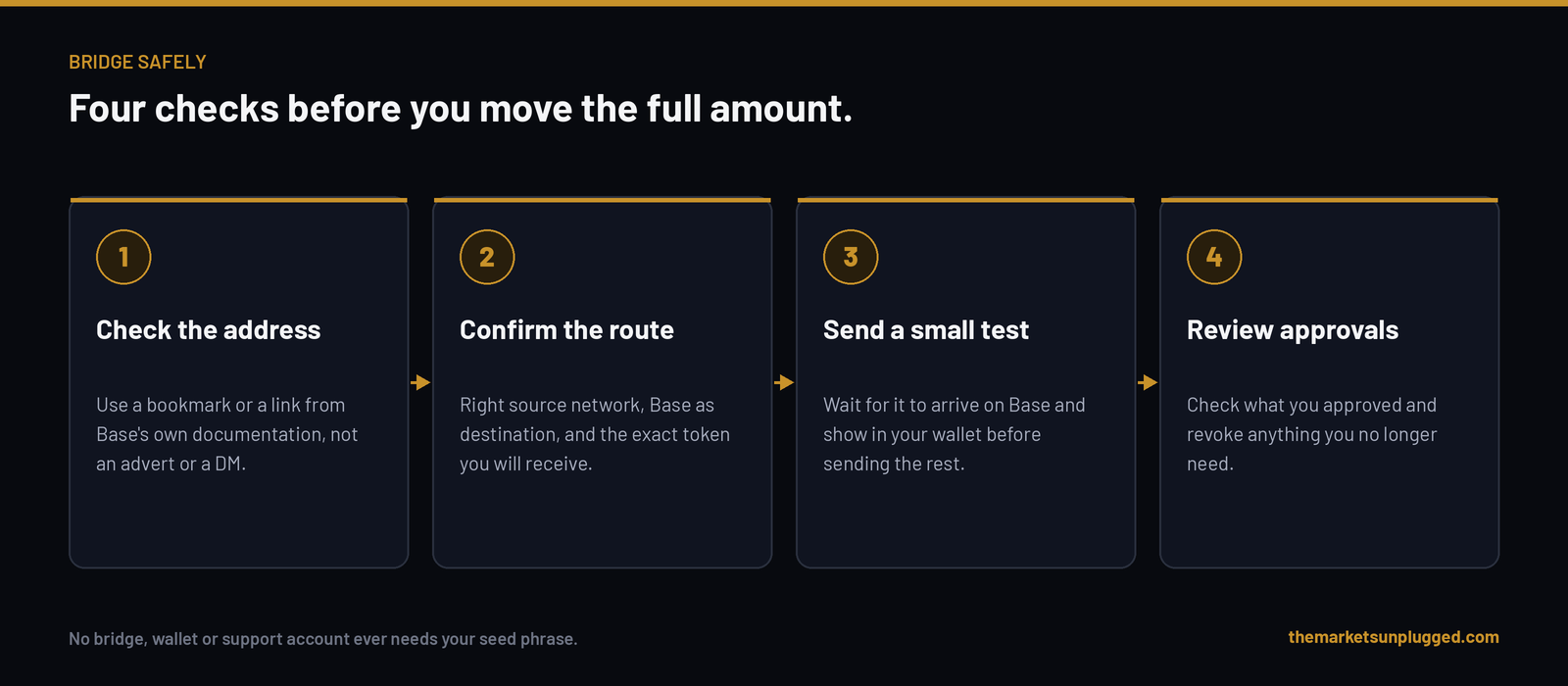
- Check the address every time. Fake bridge sites copy real ones. Use bookmarks or links from Base's official documentation.
- Send a small test first and confirm it arrives before moving the rest.
- Read what you are approving. Bridges may ask for token approvals. Our guide to token approvals explains how to check and revoke them afterwards.
- No bridge needs your seed phrase. Anyone asking for it, including a "support" account, is trying to steal from you.
What if your funds do not show up?
- Switch your wallet to Base. Funds on Base only show when your wallet is viewing the Base network.
- Add the token. Some tokens need adding to your wallet by contract address before they appear.
- Check the transaction. Look it up on a block explorer for the source network and on Basescan for Base. If the bridge has a status page, check that too.
Frequently Asked Questions
Is bridge.base.org still working?
No. Base has deprecated it and now lists independent bridges in its documentation. Be wary of any site presenting itself as the official Base bridge.
What token pays fees on Base?
ETH. Keep a small amount of ETH on Base so you can move your other tokens.
How long does bridging to Base take?
Exchange withdrawals and deposits from Ethereum usually arrive within minutes. Withdrawing from Base back to Ethereum through the standard bridge takes about seven days.
Is USDC on Base the same as USDC on Ethereum?
Circle issues USDC natively on Base, so it is the same stablecoin, but it lives on a different network. Make sure you send it to and from the right network.
We publish each market call with its date and the condition that would prove it wrong, then score it when it resolves, misses included. Anyone can check.
See the recordFurther Reading
- Crypto bridges: how to move assets between blockchains safely
- What is the difference between Layer 1 and Layer 2 blockchains?
- MetaMask setup and safety guide
- Crypto wallets hub: how wallets work and which to use
- Crypto Dictionary: every term in one place
Sources
- Base documentation, bridges and cross-chain routes: docs.base.org
- Base network information, chain ID 8453: docs.base.org
Legal And Risk Notice
This article is for education only and is not financial, investment or legal advice. Crypto assets are volatile and you can lose some or all of the money you put in. Bridges, wrapped tokens and smart contracts carry technical and custodial risks, including bugs, exploits and loss of funds. Third-party bridges named here are listed for information, not endorsed. Do your own research and consider independent advice before making any financial decision.


Discussion