

The Tape launches on 29 October for Alpha Insider members and above. It has been running live in testing for the past week, and we have changed a lot in that time. Here is what the full Tape includes, why its levels are different, what changed this week, what is still coming before launch, and the upgrades we are working on after it.
If you haven't seen it yet: every 10 seconds The Tape reads the spot order books on Binance, Coinbase, Kraken, Bitstamp and Bitfinex. It shows where big buy and sell orders are waiting, and what happens when price reaches them: the orders hold, get filled, or get pulled before anyone can trade with them.
A HEADS-UP BEFORE LAUNCH
We are still testing, so expect the odd hiccup until 29 October: a flash that arrives late, a label that changes wording, or a few minutes of missing readings. On Sunday night one flash posted to the Insider Telegram topic and dropped off the page a minute later. We found the cause and fixed it the same night. When something goes wrong, we fix it and tell you.
What's in the full Tape
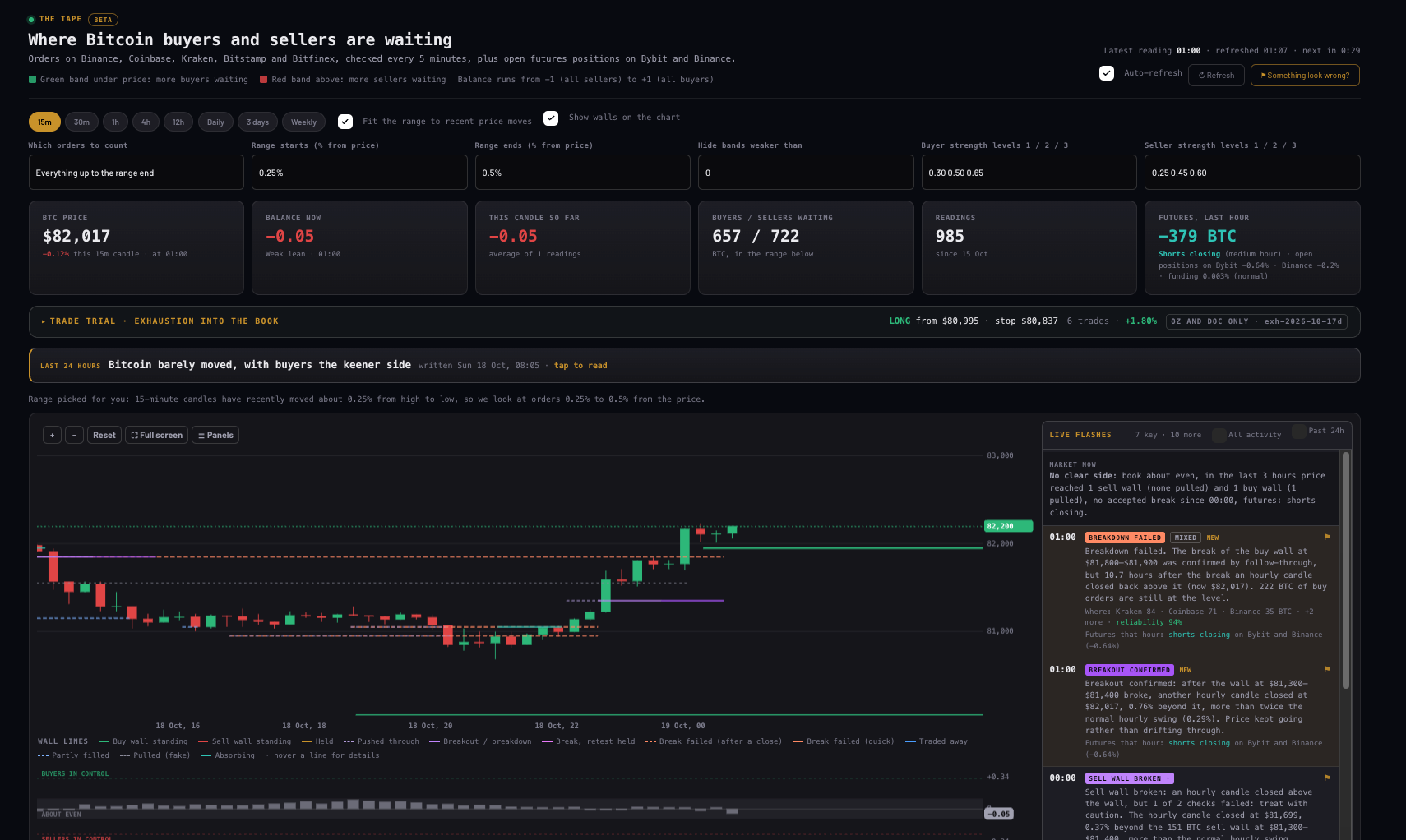
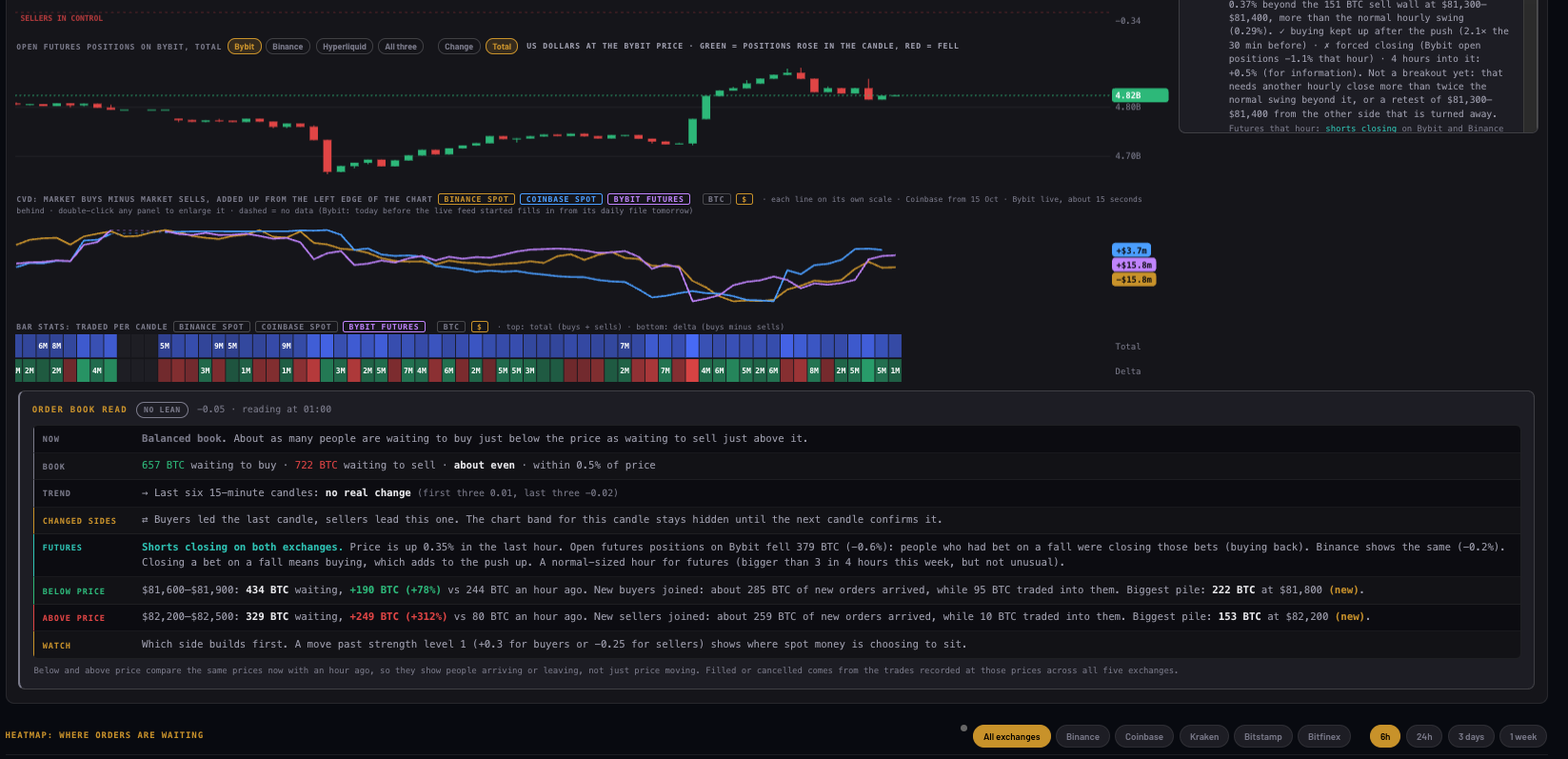
Walls on the chart. The main chart is an order book heatmap: price over time, with every big wall drawn at its price from the moment it appears. Walls fade once they are broken, pulled or traded away, so you can see which levels are still live. View all five exchanges together or one at a time, from the last 6 hours to a full week, with zoom and full screen.
The biggest walls, ranked. The three strongest buy walls and three strongest sell walls near price, each with its size, its age, which exchanges it sits on, and how long normal trading would take to clear it.
Live flashes. A running feed of what changed: walls appearing, holding, filling or being pulled, breaks and failed breaks, buyers or sellers soaking up pressure, fake walls, and zones where someone keeps placing and pulling orders.
Liquidations on the chart. Dots mark where futures traders were forced out, coloured by side, so you can see when a move came from forced closing rather than real buying or selling. OKX is live now, with Bybit and Binance being added before launch.
Futures and order flow underneath. Panels for open futures positions on Bybit and Binance, market buying versus selling, and the balance of buy and sell orders near price, all lined up with the chart.
Which exchanges you can trust. The Tape tracks how often each exchange's big orders are pulled as price gets close, and weights its walls by that.
The 8am write-up and the evening wrap. A morning summary of the last 24 hours with the levels that matter, and a 21:00 wrap of every key flash from the day and what price did next.
Why The Tape's levels are different
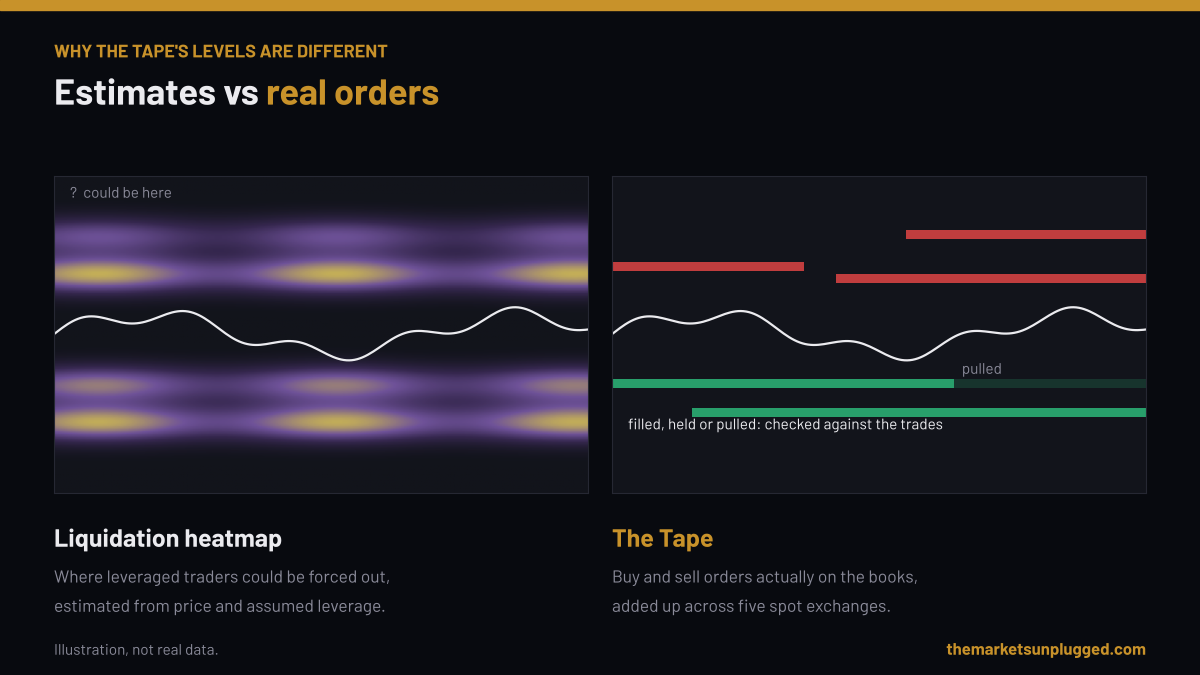
Real orders, not estimates. Liquidation heatmaps, like the one on CoinGlass, estimate where leveraged traders could be forced out, using price data and assumed leverage. They show where liquidations might happen. The walls on The Tape are buy and sell orders actually sitting on the books right now.
Spot, across five exchanges. Hyperliquid shows every order and position on its own exchange, but that is one futures venue. The Tape adds up the spot books on Binance, Coinbase, Kraken, Bitstamp and Bitfinex, where people buy and sell actual Bitcoin.
Every wall is followed to the end. A wall on screen proves nothing until price reaches it. The Tape checks the trades at that price and tells you whether the orders were real (filled or held) or for show (pulled). Walls that keep vanishing get called out as fake.
Sizes that mean something. A 300 BTC wall can be big or small depending on how busy the market is. The Tape sizes each wall by how many minutes of normal trading it would take to get through it.
You can check every flash. Every flash is time-stamped and kept, and the evening wrap shows what price did after each one, whether the level held or not.
What changed this week
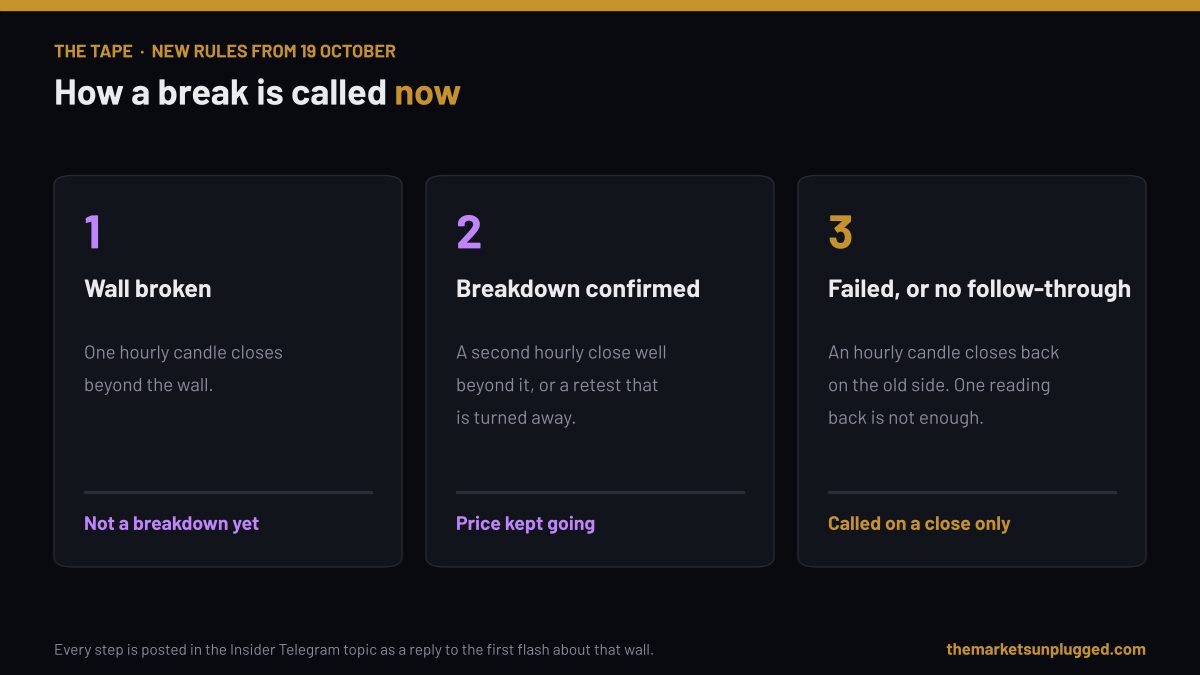
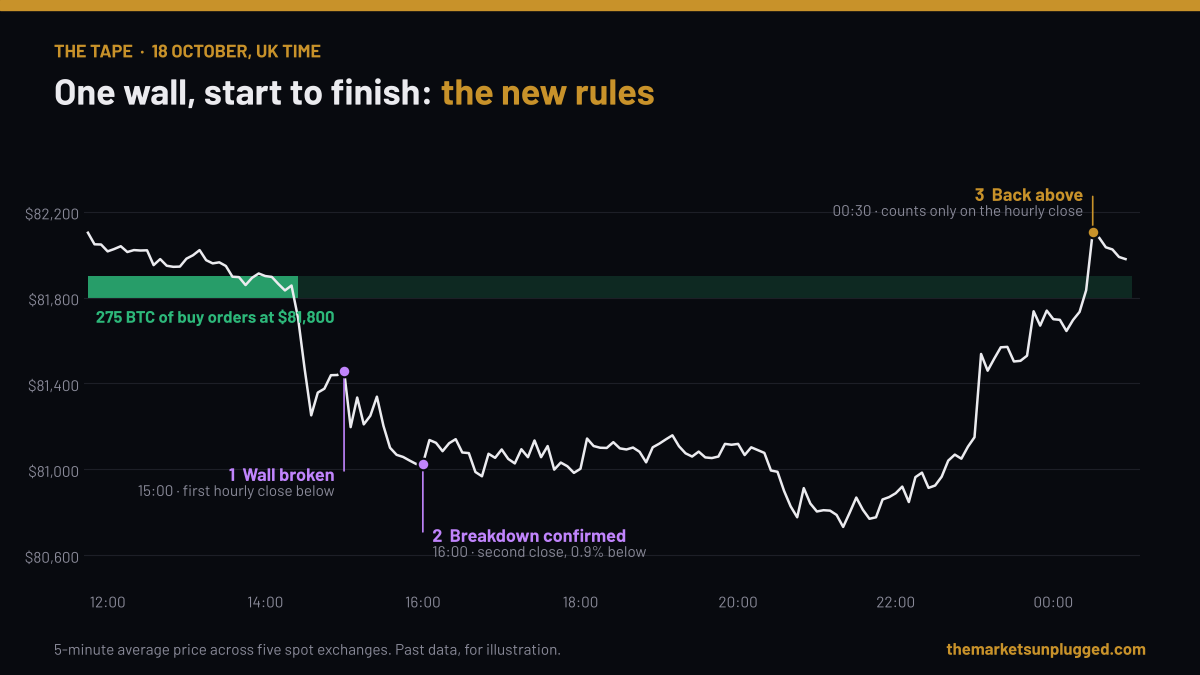
Breaks now need follow-through. One hourly candle closing beyond a wall used to be called a breakout or a breakdown. Too many of those came back within a few hours, so a single close is now just "wall broken". It becomes a breakout or breakdown only when price follows through: a second hourly close well beyond the wall, or price coming back to test the level from the other side and being turned away.
A failed break needs a close too. Price poking back above a broken level for a few minutes no longer counts. The Tape calls a break failed only when an hourly candle closes back on the old side. Until then the page shows "back above, no close yet".
Updates arrive as replies. In the Insider Telegram topic, a later flash about the same wall now arrives as a reply to the first one. You can follow one wall from start to finish without scrolling. The same flash at the same wall is not repeated within 6 hours.
Telegram flashes come from full readings only. A flash now posts only once a complete 5-minute reading backs it up. That can cost a few minutes, and it stops flashes that vanish as soon as more data lands.
A daily health check. Every morning the system checks every part of The Tape: readings, flashes, emails and Telegram posts. It also re-runs the previous day to make sure every flash that should have gone out did.
Coming before launch
One flash list everywhere. The page, the dashboard, the Insider Telegram topic and the free channel will all read the same list of flashes. A flash will not be able to show in one place and not another.
Price that moves live. The price line and the current candle on The Tape will move tick by tick, like a trading chart, instead of refreshing every couple of minutes. We want this live at launch. If testing isn't clean by 28 October, we launch with the refresh and switch live price on once it is.
Forced or chosen. When futures traders close positions, The Tape will show how much was forced (liquidations on Bybit, Binance and OKX) and how much was traders choosing to close. A short squeeze is only called a short squeeze when the forced part is large.
Who's driving the move. Bigger moves will carry a label: spot-led, futures-led, or both. It compares real buying and selling on the five spot exchanges with what futures traders did over the same minutes. In our experience, a move led by real spot buying tends to hold better than one pushed by futures bets, and now you will see which one you are looking at.
Filled or pulled, from the actual trades. When a wall shrinks, The Tape will check the trades at that exact price to decide whether the orders were filled or pulled. We are running the new check side by side with the current one first, and it replaces the current one only once it proves more accurate.
After launch: what we're working on
These are in development or being tested. They will ship when the data says they work, and some may change on the way.
Walls the moment they change. The Tape will track the order books continuously instead of in 10-second readings, so new walls and pulled walls show as they happen.
A record of every wall test. Every time price reaches a wall, we save what happened: how big it was, how old, which exchanges, and whether it held, filled or was pulled. That record lets us tune which walls The Tape flags, based on evidence instead of guesswork.
"Futures wall here too." With leverage, futures walls are cheap to place and pull, so they won't become flashes. We are testing whether a spot wall with a futures wall at the same price behaves differently. If it does, you will see a tag on that wall.
Where you will see The Tape
Alpha Insider and above: the full Tape page, every key flash live in the Insider Telegram topic, the 8am write-up by email and the 21:00 evening wrap.
Everyone: the free Telegram channel gets up to four delayed flashes a day between 08:00 and 21:00 UK time, and free members get a weekly Tape email every Sunday.
See the full Tape from day one
The Tape is part of Alpha Insider. Members get every flash live, as it happens, while the free channel sees a few of them hours later.
Or join the free Telegram channel for a taste
The Tape describes where orders are waiting and what traded. It does not forecast price, and nothing in it is financial advice. Order books change fast, and walls can be placed and pulled in seconds.




Discussion